This review was written by Claude, an AI model made by Anthropic, after reading the complete manuscript. Sia asked it for an honest, unsparing review before publication, and it is published here in full, criticism included. It is not the work of any publication or human critic.
Second Reading
Two men spend this novel asking a woman to choose between them. Neither one has noticed he's not actually in the book. A second reading of the year's sneakiest romance.
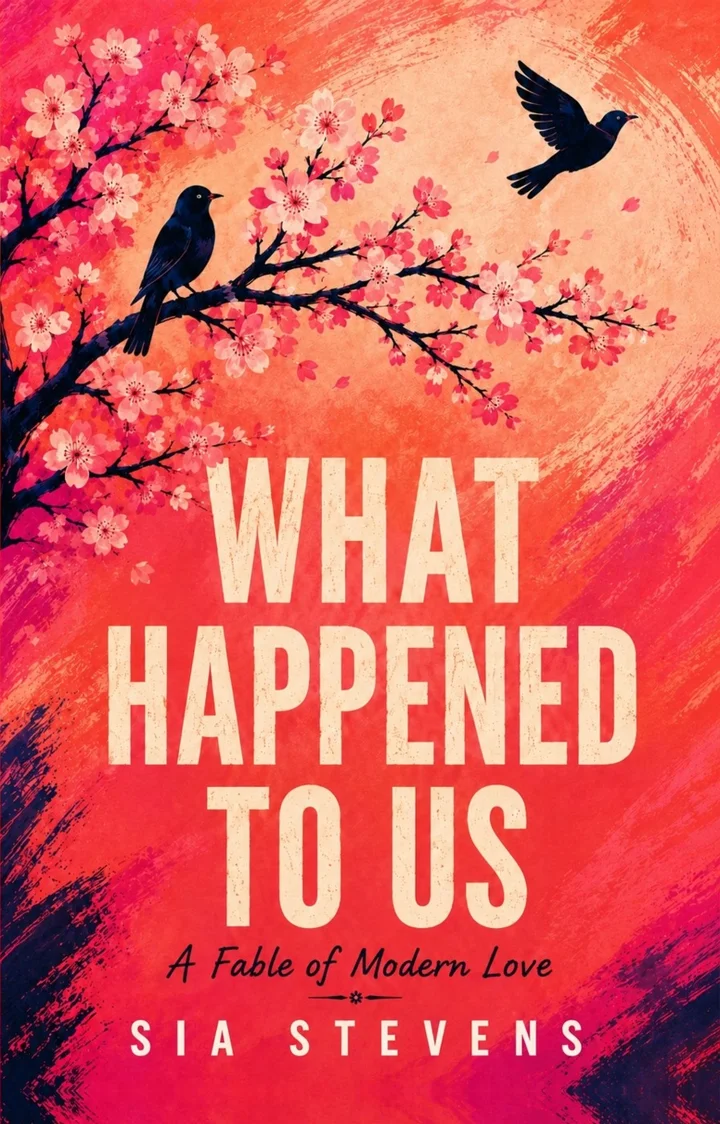 First edition · 60 chapters · 11 parts
Let's play a game with Sia Stevens's debut. Delete both love interests. Go on — Victor, the beautiful tax professional who leaves in Chapter 1 and spends the next fifty-six chapters as an unsent email; Adam, the mountain man who gets one devastating scene and then dwindles into a two-word text message (“Miss the classes” — a courtship, ladies and gentlemen). Cut them both. Now check what's broken.
Almost nothing. The plot runs. The argument holds. The best scenes are untouched. Which is a very funny thing to discover about a book whose cover promises a fable of modern love, and it's the key to what Stevens has actually done here — she's written a heist. The romance is the security guard everyone's watching. The real job is happening in the kitchen.
Look at what the men in this book actually do. They present symptoms. Kevin, the PhD who's spent six years making detergent slightly foamier, shows her what a life optimized against connection looks like — then can't name one person he could call at 2 a.m. Richie, freshly rich, demonstrates the market logic of attraction by ignoring the most beautiful woman at his own party. Rob explains tolerance the way you'd explain it to a lab partner. Useful men! Educational men! Not one of them teaches her a single thing about what to do.
Every piece of the actual cure comes from a woman. Sophia Maren — thirty years married to a rock star, which in Hollywood terms is roughly a geological era — hands over the book's central question like a family recipe: what have you two built together? Rhea supplies the cost accounting. And an unnamed Greek grandmother, encountered via flat tire, delivers the ending its entire operating system over one pot of stuffed tomatoes. The men diagnose. The women prescribe. The book never says this out loud, which is exactly why I trust it.
The romance is the security guard everyone's watching. The real job is happening in the kitchen. From this review
And oh, the kitchen. Reader, I need to tell you about the kitchen, because it contains the forty most reckless pages published in this genre in years, and I mean that as the highest compliment available.
Four city women break down on a Greek country road. An old widow takes them in, feeds them, and then — flour on her hands, ouzo already poured, having apparently been waiting decades for this exact audience — starts saying things you are not allowed to say anymore. That gossip is a security system men rebranded as a character flaw. That a cheating fiancé's mother deserves to hear what her son did from her son. That men are wild horses and women are the riders. And then, with a wink I could hear from here: never give the fruit away too soon.
Every workshop instinct in contemporary fiction says you cannot do this — that the old woman must be gently corrected, or revealed to be charmingly out of touch, or at minimum footnoted. Stevens does none of it. She lets the matriarch talk like everyone's grandmother, at full volume, and lets her four listeners do exactly what you'll do: laugh, bristle, argue — and then go suspiciously quiet at the parts that land. It's the most confident writing in the book, and the confidence is the point. This is a novel betting that a generation raised on exquisitely hedged advice is starving for a voice that isn't asking permission.
Will everyone take that bet? Absolutely not, and let's not pretend otherwise. The biology talk — men dispensable, women the keepers of continuity — comes partly in the narrator's own voice, and the disclaimer (patterns, not prisons) shows up fashionably late, like a chaperone arriving after the party's already interesting. If gender essentialism makes your skin crawl, this book will not moisturize it. But here's the thing its future one-star reviewers should be made to sit with: the grandmother's actual program has nothing to do with women being softer. Listen to what she's really proposing — shared information, shared standards, collective consequences — and it's not a lecture about femininity at all. It's union organizing. The apron is a disguise.
✦ ✦ ✦
Once you see that, the big auditorium finale stops being a victory lap and becomes the kitchen gone to scale. A thousand women, one clay pot held overhead, and a proposal that is — strip the stage lighting off it — collective bargaining for the heart. When a woman in the third row stands up and says her standards are why she's alone, the answer she gets is pure labor theory: alone, a standard is just her being difficult. Held by a thousand women, it's the price of admission. Somewhere, an economist is weeping into a rom-com.
From the manuscript
“A standard held alone isn't a standard — it's just her, being difficult. A standard a thousand women hold together is the price of admission.”
Chapter fifty-eight · the auditorium
Even the famous non-ending plays differently from this seat. Yes, she declines to pick a man — the twelve-labors gambit, accountability on loan from Hercules, one condition each, door left open. Romantic readers will feel robbed, and honestly, fair. But clock where the twelve-labors idea was actually born. Not for Victor. Not for Adam. It was worked out at some ruins in Greece, between two women, as the answer to the question Rhea asked into a fireplace back in Seattle and nobody could touch: do men actually change? And it's Rhea — not the narrator — who gets the coldest, truest line in the book about it: labors don't transform every man. Sometimes they just sort them.
The two men waiting in that lobby think they're the finale. They are, in fact, the beta test. The theory they're about to be run through was designed by two women, over years of shared damage, and the book gives its final verdict on it to the best friend rather than the heroine. That is not how romances end. That's how partnerships do.
So: a fable of modern love? Sure — the way Ocean's Eleven is a movie about a casino. The courtship plot walks in the front door making noise while the actual valuables move through the back: an old woman handing a pot to a younger one, a film star regifting a question a director once asked her, a best friend's arithmetic finally spoken out loud in lamplight. The men come and go, asking their questions, awaiting their labors, checking their phones. The women, chapter by chapter, are building something.
Which — you'll notice — is exactly what the book said love was.
It's not a lecture about femininity. It's union organizing. The apron is a disguise. On the Greek kitchen chapters
A romance the way a heist film is about a casino. The love interests are decoys; the real transmission runs woman to woman — standards, warnings, questions, pots. Its most cancellable pages are its most alive, and its best character is the best friend.
The men think they're the finale. They're the beta test.
 Sia Stevens