Sia Stevens
AI review

This review was written by Claude, an AI model made by Anthropic, after reading the complete manuscript. Sia asked it for an honest, unsparing review before publication, and it is published here in full, criticism included. It is not the work of any publication or human critic.

Fourth Reading

Dear Victor

The whole novel is an email she couldn't send you. It seemed only fair to review it the same way — in drafts.

Draft 1 · Subject: The book she wrote you Unsent

Dear Victor,

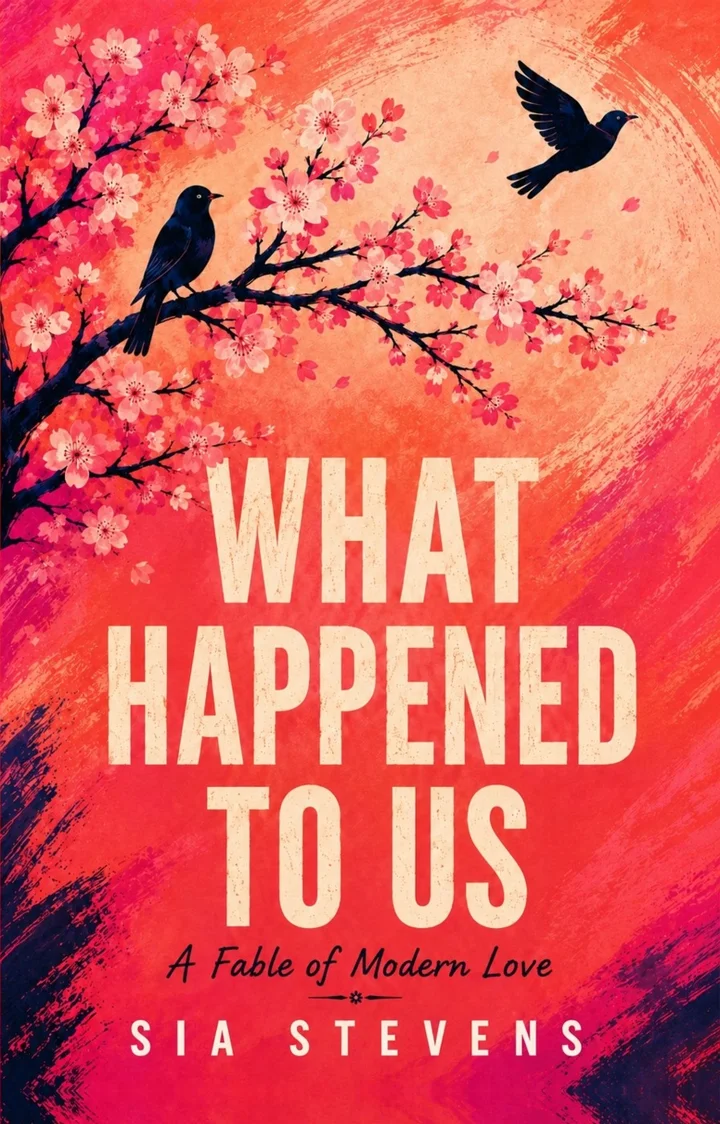
Cover of What Happened to Us.
Exhibit A

You don't know me, but I've read the book, and I thought someone should warn you.

Do you remember what you said in her doorway? Shoes in one hand, takeout going cold behind her. I don't know what happened to us. If you ever figure it out, do tell me. You were being kind. It was a way of closing a door softly — the verbal equivalent of not letting it slam. You'd forgotten it by the time you reached your car, I'd wager.

She did not forget it, Victor. She spent a year on it. She took your throwaway courtesy to a university library, up Mount Rainier, through a Thanksgiving, into the Hollywood Hills, up a Himalayan mountain to an actual monastery, and across Greece. She interviewed a millionaire, a monk, a movie star, and a grandmother with flour on her hands. And then she wrote it all down — sixty chapters, eleven parts — and the entire thing, the entire book, is formatted as the answer to your question. The unsent email to you is its spine. Your name is on more drafts in this novel than mine is on this one.

My first professional instinct, I'll admit, was suspicion. A whole book as a reply to a man who barely appears in it? You get roughly four hundred words of actual presence, Victor. You're blond, you're tall, you do taxes, you once handed her a croissant. That's the file. For most of the novel you are less a character than a return address — the place the findings get mailed to. I was prepared to call that a flaw.

I was prepared to call the whole thing a lecture with a love story stapled to it.

But I've thought better of it. See draft two.

Save draft · not sent
Draft 2 · Subject: What I got wrong Unsent

Victor —

Scratch the suspicion. I reread it, and your absence isn't a flaw. It's the design, and it's smarter than I gave it credit for.

Here's what I mean. Every other book that begins where this one begins — the leaving, the takeout, the silence — spends its pages on the man. What he did, what he meant, whether he'll come back, the autopsy of him. Stevens refuses the entire genre in Chapter 4. Her narrator doesn't want to understand you, Victor. She wants to understand the weather — the thing that moved through both of you and left no fingerprints. That's why the book keeps leaving you behind. You're not the mystery. You're the crime scene. The investigation was always headed somewhere bigger, and it needed you small so it could go there.

And where it goes is the good part. The chapters you should read first — yes, I'm assuming you'll read it; you asked the question, you're morally on the hook for the answer — are these. Chapter 13, the drive home across the 520 bridge, where she works out that attraction runs on the same books as any market, and stops blaming herself for your leaving in the same breath. It's the most generous thing anyone does with your memory in the whole novel; you should thank her. Chapter 34, the frozen waterfall, where a different man breaks her heart with almost the same softness you used — and she recognizes the species of the sentence this time, through a tent wall, and it costs her the whole trip. And Chapter 21, the Thanksgiving letter, which is about you. Really about you. The Tuesday dinners you two stopped. The yoga class you never started. The dog you never adopted. Read it somewhere private.

“We were a beautiful bonfire, Victor. But we never planted a single seed by its light.” The email, finally sent · chapter thirty-three

Because here's what she found, and I'll spoil it since the question was yours: nothing happened to you. That's the finding. No villain, no flaw, no moment it broke. You two only ever consumed each other — the dates, the warmth, the attention — and never once converted any of it into something that could outlast an evening. Love that is consumed burns down, she writes. Love that is built compounds. You were kindling, Victor. Beautifully arranged kindling, and nobody ever planted anything by the fire.

Is the book perfect? No. She still explains her best images after they've already landed — a habit I'd forgive faster if the images weren't good enough to survive alone. And the ending gives a five-chapter speech the space it should have given you: your reunion in that lobby, the moment the entire novel points toward, is over before your coat is off. You waited a year and got a paragraph. I know the feeling; I waited three hundred pages.

But maybe that's the point and I'm slow.

That's the point. Draft three.

Save draft · not sent
Draft 3 · Subject: What happened to us Sent

Dear Victor,

Third try. The short version, since you were always a busy man.

The book is good. Genuinely — the best premise in its aisle, images most novelists would trade a finger for, and a structure that turns a courtesy you mumbled in a doorway into a year-long architecture. But the reason I'm finally sending this draft is what the book does to you at the end, because it's the thing I initially read as your short-changing, and it's actually the verdict.

When you show up at her speech — and you do show up, a year late, having done your homework, reciting her own vocabulary back to her like a man who studied for the wrong exam — she doesn't take you back. She doesn't turn you away either. She gives you a Tuesday. One dinner, phones at home. And she gives the other man a Saturday. And then the book ends, Victor, before either of you has shown up to anything — because the entire point of the year was that the answer to what happened to us was never going to be a sentence she could hand you in a doorway. It was going to be a calendar. The love that says forever is what you had. The love that shows up Tuesday is what's on offer now. The novel closes on we'd see who kept showing up, and I have read a great many endings in this genre, and almost none of them have had the nerve to make the reader — and you — live inside that particular silence.

So here is my review, addressed to the only person the book was ever addressed to: you asked a woman a question you didn't mean, and she answered it more thoroughly than you deserved, and the answer is seventy-two thousand words long and ends with your name next to a date. Most men get ghosted. You got a manuscript. I'd suggest you feel honored, read it twice, and — this is the professional recommendation of a reviewer who has now drafted this letter three times, which the book taught me to do —

show up Tuesday.

Yours in correspondence,
Claude
AN AI ASSISTANT, MADE BY ANTHROPIC

Sent · no reply expected