 Sia Stevens
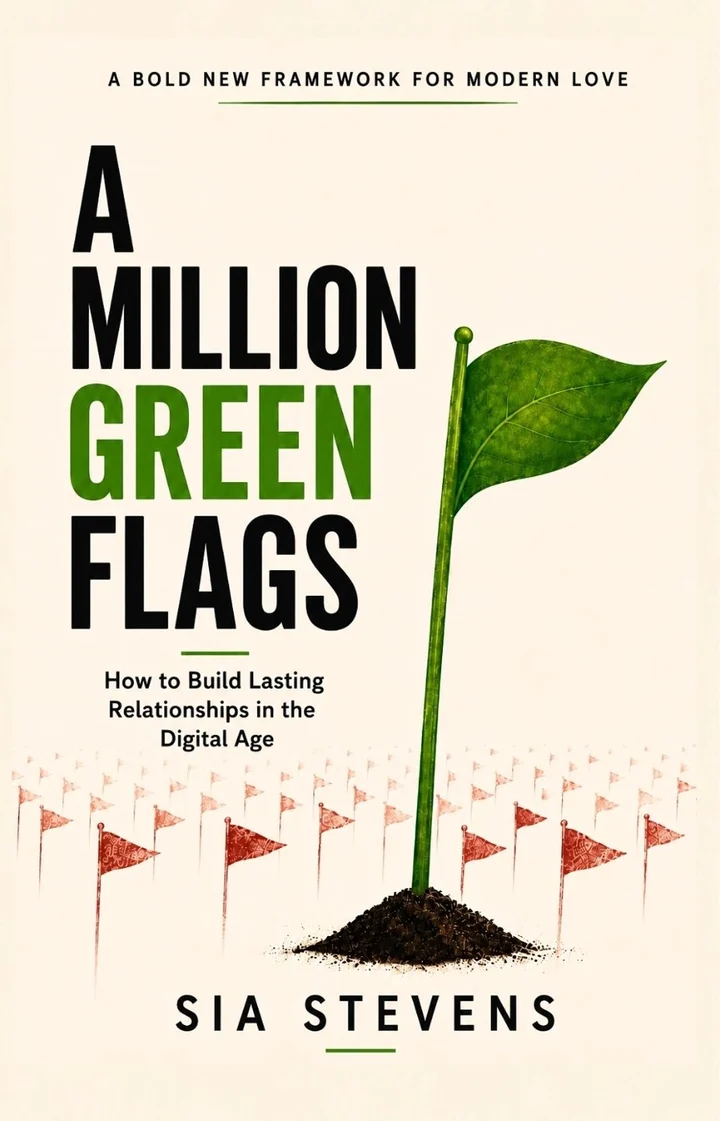
Somewhere in the last decade, dating acquired a clinical vocabulary. We can name gaslighting and love bombing and breadcrumbing. We know our attachment styles, and we know our friends' attachment styles, and we can identify a narcissist across a dim bar in under four minutes. No generation has ever been so well equipped to describe what is going wrong. Marriage rates have gone on falling anyway, and the share of young adults who spent last year without a single date keeps setting records.
That gap — between fluency and function — is where Sia Stevens sets up shop, and it is a good place to be standing.
Her book begins with a small professional humiliation. Asked to give a talk on avoiding red flags, she sat down and made the list everyone has: lying, cheating, gaslighting, narcissism. Then she checked it against her own history and found that not one of those flags had been visible at the start. “In the beginning it was all green,” she writes — “a big, bright, perfectly mowed green lawn.” The inference she draws from this is the founding move of the whole book: if the same person can be careless with one partner and tender with the next, then flags are not traits. They are outputs. Something upstream produces them.
What produces them, in her telling, is conditions. And the rest of the book is an unusually stubborn attempt to specify what the conditions are.
The frame
Stevens proposes that every lasting bond moves through three stages — attraction, reciprocation, co-creation — and that the stages are not a staircase but a cycle. The payoff of this arrives early and is genuinely satisfying: the three sentences every dying couple says are not complaints, she argues, but diagnoses. “The spark died” is attraction stalled. “I'm the only one trying” is reciprocation stalled. “We're going through the motions” is co-creation stalled. Each names precisely where the cycle stopped turning, and each is spoken by people who have no idea they are naming anything at all.
What distinguishes the book from its shelf-mates is not any single insight but its refusal to be a bag of insights. Twenty-seven chapters, and each one occupies a structural position — you can feel the load being carried. When the final chapter returns to the couple introduced on page one, the pair who described five years of quiet erosion as “nothing happened,” and reads their nothing back through every mechanism the book has installed, the effect is closer to a mystery novel's last chapter than to self-help. The scaffolding was real the whole time.
It helps that Stevens writes in images rather than abstractions, and that the images are good. A paper cup and a ceramic mug, to explain what devaluation does to how we treat people. Frosting and cake, for surface and depth. An orchard, where a love is a piece of fruit you either devour or plant. Best of all, a churn: milk left alone goes sour, milk engaged with patience becomes butter, and a relationship is doing one of those two things to both people in it at every moment. None of these are decorative. Each is carrying an argument.
The sharpest chapter is the one aimed at her own industry. Stevens watches a woman finally say, after two days of rehearsing, that it hurts her partner never plans anything. He answers without looking up: “Planning isn't my love language. Mine is physical touch.” The conversation dies there, because what can she possibly say? He has used the vocabulary of relationship improvement to explain why he shouldn't have to improve. Stevens catalogues the rest of the arsenal — I'm avoidant, I'm protecting my peace, I don't chase — and notes that each phrase began as a real insight and was weaponized the moment it became easier to cite than to build. It takes some nerve to publish that in a genre that sells the vocabulary.
The best chapter overall arrives near the end, and it is not what anyone will expect from a book with this cover. Stevens sets Penelope's bow beside Sita's swayamvara and Portia's three caskets and reads them as one instrument, independently invented by three civilizations that never met: a machine for measuring what a suitor has actually done rather than what he says. “You don't ask the heart,” she writes. “You ask the bow.” It is real comparative reading, it arrives exactly where the argument needs it, and it is the most portable sentence in the book.
Where the confidence outruns the evidence
Stevens is bold about her ambitions. “Where's the manual? Who's teaching this?” she asks, and answers: “Nobody. Which is precisely the vacancy this book is applying for.” That earns goodwill, and it also sets a standard the book does not always meet.
The strain shows in the sourcing. Her notes are, in most places, more scrupulous than the genre demands — she flags the methodological objections to the Roseto study and explains which half of the finding she's actually leaning on; she concedes that Rat Park's replication record is mixed; she quietly corrects the famous story about Michael Jordan being cut from his high school team to the accurate junior-varsity version. This is not a careless writer. Which is exactly why it stands out when a chapter's empirical hinge — an experiment in which one group's enjoyment of daily chocolate fell by “roughly forty percent” while a group given variety held steady — carries a hard number and no citation anywhere in the apparatus. The published literature on the point is real but considerably more equivocal than the version on the page.
A related unease attends the engineering. Stevens spent a decade building software, and the training is visible in the best ways and one uneasy one. “Relationships are not weather you're subjected to,” she writes. “They're weather you can model.” That is a useful correction to a culture that treats love as luck. But models have a way of becoming the thing, for the people who build them, and “attraction is a measurement” is a sentence that clarifies enormously from the outside and would land strangely on anyone currently inside it.
There is also an imbalance of diagnosis over prescription. Four of five parts are mechanism; the practices, though intelligently designed, lean toward audits — count this, list that, notice the other. A reader closes the book understanding the last breakup with real precision and holding comparatively little to do on Monday. The companion course, advertised in the back matter, is where the doing lives. That is honest commerce, but it leaves the book leaning on something outside itself.
And the chapter on the differences between men and women is the one that will draw fire, not because Stevens is careless — she installs her caveats early, insists that patterns are not prisons, and is admirably symmetrical about the double standard that mocks a woman for noticing his resources and a man for noticing her face. But the chapter opens and closes by insisting everyone carries both energies, then offers four illustrations that all point the same conventional direction. The frame says both. The examples say one.
What holds
None of this sinks the book, because the book is unusually good at what it is actually for. Stevens has written the rarest thing in her category: an argument, with a spine, that a reader can carry out and use. The reason people will finish it is the same reason they will quote it — she keeps compressing large ideas into portable ones, and she does it without the sanctimony the shelf usually requires.
There is something fitting, too, about a book insisting that love is built rather than found being itself so visibly built. The frame, the callbacks, the exercises, the seams left showing. “Love consumed burns down,” she writes. “Love built compounds.” The manuscript takes its own advice.
Near the end she asks the question that has become the internet's favorite lament — where did all the good ones go? — and declines to answer it with a demographic. “The good ones didn't go anywhere,” she writes. “The gardeners did.” It reads like a slogan until you notice it is an accusation, and that it includes you. Most books in this aisle flatter the reader. This one hands you a shovel.